

Your search terms report is a graveyard
Smart bidding learns from whatever it's fed. Without disciplined negative-keyword pruning, you're paying for 'free,' 'DIY,' 'jobs,' 'salary,' and a hundred other terms that will never convert.
Fix This For MeMost Google Ads accounts bleed budget on broad-match searches that never had a chance of becoming customers. Get Us Listed handles paid search management for businesses in York PA and across the Mid-Atlantic, rebuilding around buyer-intent keywords, geo-modified targeting and a dedicated landing page per campaign — so the budget follows people who are ready to buy.
Before we touch a budget, we look at four things. In the accounts we audit, these are where wasted spend hides — and every one of them is a fixable problem, not a fact of life.
Smart bidding learns from whatever it's fed. Without disciplined negative-keyword pruning, you're paying for 'free,' 'DIY,' 'jobs,' 'salary,' and a hundred other terms that will never convert.
Fix This For Me
A homepage is a menu, not a sales pitch. Each campaign needs a dedicated landing page with one offer, one CTA, and zero navigation distractions.
Get SEO
Form submissions firing on every page load. Phantom calls. Duplicate conversions across GA4 and Google Ads. Smart bidding optimizes toward whatever you call a conversion — make sure that's the right thing.
Get a Better Website
Set-and-forget accounts decay quickly. Weekly negative-keyword adds, geo-modifier bid adjustments, and fresh creative every 14 days are the difference between an account that erodes and one that compounds.
Let Us Handle ItFive parts of a paid campaign, and which of them is usually the one wasting your budget.
Ads are the right answer when you need enquiries before organic work can plausibly deliver them, when demand is seasonal and short, when you are testing whether a service sells at all, or when the organic results for your term are held by national sites you will not displace soon.
They are the wrong answer when the site cannot convert the traffic. Paying for clicks to a page that loads slowly, does not work on a phone, or does not say what you charge is buying the same visitor twice and losing them both times. We would rather fix that first and take less money now.
The honest framing is that the two channels solve different problems on different timescales — organic traffic versus paid ads goes through when each makes sense, and local SEO is the slower, cheaper-per-lead half of the pair.
The single most common waste in a small account is match type. Broad match hands Google latitude to show your ad for things that are adjacent to your term rather than the same as it, and on a modest budget that latitude is expensive: a plumber pays for “plumbing courses” and “plumbing supplies” before the budget reaches anyone with a leak.
So: phrase and exact match for the terms that carry buying intent, broad only where there is enough budget to learn from it, and a negative keyword list that grows every week from the actual search terms report. That report is the most useful screen in the account and the one most rarely opened.
Intent matters more than volume. “Emergency plumber near me” at low volume outperforms “plumbing” at high volume, because one of them is a person with water on the floor. Google’s keyword matching options covers the mechanics.
Sending paid traffic to a homepage is the default and it is almost always wrong. A person who searched for one specific thing and clicked an ad promising that thing should land on a page about that thing — not on a general introduction to the business with the answer three clicks away.
A landing page that works matches the promise in the ad word for word, states the price or the range, shows the service area, and makes the action obvious above the fold on a phone. Removing navigation is sometimes right and sometimes patronising; what is always right is not making the visitor hunt.
Location-specific pages are a particular trap: twenty pages differing only by town name are a doorway scheme, they read as one to a search engine, and they convert badly because they say nothing. What to include and what to avoid on location pages is the longer version.
Every account needs a period where it is gathering data rather than performing, and a budget too thin to produce conversions never leaves that period. If the realistic cost per click in your market is eight dollars and you are spending ten a day, the account cannot learn, automated bidding has nothing to optimise toward, and the money goes anyway.
It is usually better to advertise one service properly in one area than five services thinly everywhere. Narrow the geography, narrow the hours to when someone answers the phone, and let the budget concentrate.
We will tell you if the budget you have in mind is below the level where paid search can work in your market, and what it would need to be. That conversation costs us the sale sometimes. It costs you more to find out three months in.
An account can look healthy on impressions, click-through rate and cost per click while producing nothing the business can bank. The numbers that matter are enquiries and what each one cost.
That requires conversion tracking that actually fires — form submissions and phone calls both, including calls from the ad extension rather than only from the website. It is worth checking rather than assuming: a surprising number of accounts have been reporting conversions from a tag that stopped working after a site change.
You keep the account and its history. It is created in your name, we are granted access to it, and if we part company you revoke that access and everything stays where it is. An agency that runs your ads inside its own account is holding your data hostage by default, whatever the intention. How to use Google Analytics covers reading the rest of it yourself.

We don't run a platform because we have a partner badge for it. We run it because it's where your buyers are at the moment they're ready to act. Here's exactly what we manage.
Tightly themed ad groups built around buyer-intent keywords, geo-modifier bid adjustments, and conversion tracking that fires only on real leads — not pageviews.
Lookalike audiences modeled off your best customers, retargeting funnels for site visitors who didn't convert, and creative refreshed every two weeks to fight ad fatigue.
Every campaign gets its own purpose-built page. One headline, one offer, one CTA, sub-2s load time. Built into the engagement — never billed separately like other agencies do.
A live Looker Studio dashboard tied directly to your accounts. Every keyword, every CPL, every conversion path. No proprietary platforms, no hidden math, nothing to hand back if you leave.
We comb through your search terms reports, conversion paths, and competitor spend on Auction Insights. Then we agree a target cost per lead with you in writing — before the first dollar moves.
Fresh ad groups, dedicated landing pages, server-side conversion tracking, and a clean negative-keyword foundation. Everything is built in your accounts so you keep it forever.
Negative-keyword pruning, geo-modifier adjustments, smart bidding tuning, and creative tests every single week. You see exactly what changed, why, and what it cost — every Friday.
Budgets, ownership, and when we would tell you to stop.
Enough that the account can produce conversions consistently, which depends entirely on what a click costs in your market. A cabinet maker and a personal injury attorney are not in the same conversation, and any agency quoting a universal starting budget is quoting a number it made up.
The way to find out is to look: the planning tools give a realistic cost-per-click range for your terms and your area before a single dollar is committed. We do that first and show you the numbers.
Our fee and your ad spend are separate lines, always. A single blended number makes it impossible for you to see what reached Google.
Usually one of four things. Competition — someone with a bigger budget is bidding the same term. Quality Score — Google charges more when the ad and the landing page are a poorer match for the query. Match type — broad match is entering auctions you would not choose. Or geography — a radius wide enough to include a major metro brings that metro’s prices with it.
The one you can most directly influence is Quality Score, and that is a landing-page problem more often than an ad-copy problem.
If the honest answer is that your market is expensive and your budget cannot compete on the head terms, we say that, and the recommendation becomes narrower terms or a different channel.
Yes. It is created under your business, with your billing, and we are added as a user. If we stop working together you remove our access and the account — history, conversion data, learning — stays with you.
This is worth insisting on with anyone. An account owned by the agency means starting from zero when you leave, which is a switching cost disguised as a convenience.
They catch people at different moments. Search ads reach someone who has already decided they need the thing and is choosing who provides it. Social ads reach someone who was not looking, which is better for awareness and for services people do not know to search for, and worse for urgent needs.
For most local service businesses with a limited budget, search comes first, because intent is already there. For a new offering nobody is searching for yet, that logic reverses.
Growing your business with Google Ads covers the search side in depth; social media marketing is the other half.
Both are real channels and both are easy to waste money on. Display in particular has a default setting that will spend your budget across apps and sites with no relationship to your business unless the placements are managed.
They earn their place when there is something to remarket to — an audience that already visited — or when the offering genuinely needs showing rather than describing. As a first channel for a local service business with a small budget, they usually do not.
The guide to YouTube TrueView ads and Google gallery ads go through the formats.
When the cost per enquiry stays above what an enquiry is worth to you after a fair test, and narrowing the terms, the geography and the hours has not closed the gap. At that point continuing is a transfer from your business to Google and to us, and we would rather say so.
Also when the constraint is somewhere else. If enquiries are arriving and not being answered for two days, more enquiries is not the fix — and we can see that in the response times.
Working out the threshold in advance makes this conversation factual instead of awkward: what a lead is worth is the number to establish first.
It depends heavily on trade and ticket size, but a healthy benchmark range is $35–$120 for residential service trades and $90–$280 for commercial or high-ticket work. We set a target with you up front and tune the account toward that number, not toward impressions or click volume. CPL, CTR, and the rest of the alphabet soup are all defined in our plain-English marketing glossary.
No. Flat monthly management fee — period. Percentage-of-spend pricing creates an incentive to push budgets up regardless of performance. We win when your CPL drops, not when your spend climbs. For an industry example, see how paid search works for HVAC companies in York or auto repair shops in Washington DC.
You do — 100%. We build campaigns inside your Google Ads and Meta Business accounts, your audiences, your conversion data. Leaving us means changing one user permission. Everything stays with you. Account ownership is one of the commitments we compare side-by-side on the why Get Us Listed page.
Smart bidding (Maximize Conversions, Target CPA, Target ROAS) lets Google’s algorithm set bids based on signals manual bidding can’t see. We use it on accounts with at least 30 conversions per month and clean conversion data — and never on accounts that don’t meet both.
Search campaigns typically generate qualified leads in the first 7–14 days post-launch because intent is already there. Meta lookalike and retargeting campaigns take 30–60 days because the algorithm needs volume to learn your audience.
Enough to buy a meaningful number of clicks in your trade and county — and that varies too widely for a one-size number, because a click costs very different money for an emergency plumber than for a landscaper. During the audit we pull real cost-per-click data for your keywords and area, then recommend a floor budget. If the honest floor is more than you want to spend, we’d rather concentrate on one service in one area than run everything underfunded.
For eligible trades, usually yes. Local Services Ads sit above regular search ads, charge per lead instead of per click, and carry Google’s screening badge. They complement search campaigns rather than replace them — LSAs capture the buyers who call straight from the top of the page, while search campaigns give you control over messaging and landing pages. We handle setup, profile optimization, and disputing the junk leads Google will otherwise happily bill you for.
Because you pay for searches, not keywords. Bid on ‘roof repair’ and without negatives you can pay for ‘roof repair jobs,’ ‘DIY roof repair,’ ‘roof repair training,’ and dozens of other searches that will never become customers. Negative keywords tell Google which searches to never show your ad on. We prune the search-terms report weekly, and over time that growing negatives list becomes one of the most valuable assets in your account.
With tracking numbers that forward instantly to your real line — callers notice nothing, and each call is tied back to the campaign and keyword that produced it. We count a call as a conversion only past a duration threshold, so misdials and spam don’t inflate your numbers. One note on recording: Pennsylvania and Maryland both require all-party consent, so call recording is optional and only enabled with a compliant notification message.
Yes, because the money never passes through us. Your ad spend goes directly from your card to Google or Meta, and you can see their invoices in your own account anytime. Our flat management fee is a separate line item, so there’s no bundle to untangle. You also get the live dashboard plus a weekly note listing every change we made in the account and why — no mystery hours, no markup.
Usually the landing page decides whether the budget works. Ads buy the click; the page has to earn the call. If yours is slow or unclear, web design comes first — otherwise you are paying Google to send people to a page that loses them.
There are two ways to run Google Ads for a service business, and they look almost identical from the outside. A clicks-focused account optimizes toward traffic: strong click-through rates, cheap clicks, a monthly report full of charts. A call-focused account treats a ringing phone as the only outcome that counts. That means call assets on every ad, phone calls tracked and counted as conversions with a duration threshold so a misdial doesn’t count, ads scheduled for the hours someone actually answers your phone, and bids tuned toward the keywords that produce booked jobs rather than the ones that produce cheap traffic. Same platform, completely different account. The second one is the one that pays your bills.
One of the most common leaks we find in local ad accounts is geographic: budget quietly spent on searchers who could never become customers. Google’s default location setting includes people merely interested in your area — someone three states away researching York County can trigger and click your ad. We switch targeting to people physically located in your service area, build it county by county to match where your crews actually go, exclude the towns you don’t serve, and adjust bids toward the areas that send you your best jobs. For a business serving south-central Pennsylvania and northern Maryland, that discipline alone changes what the same monthly budget produces. Every dollar stays inside your map.
Three free ways to see exactly where you stand — two run instantly in your browser, one is a real audit by a real strategist.

Ten yes/no questions — the same ones we open paid audits with. Instant score and a personalized gap list. Nothing is submitted anywhere.
Run the free check →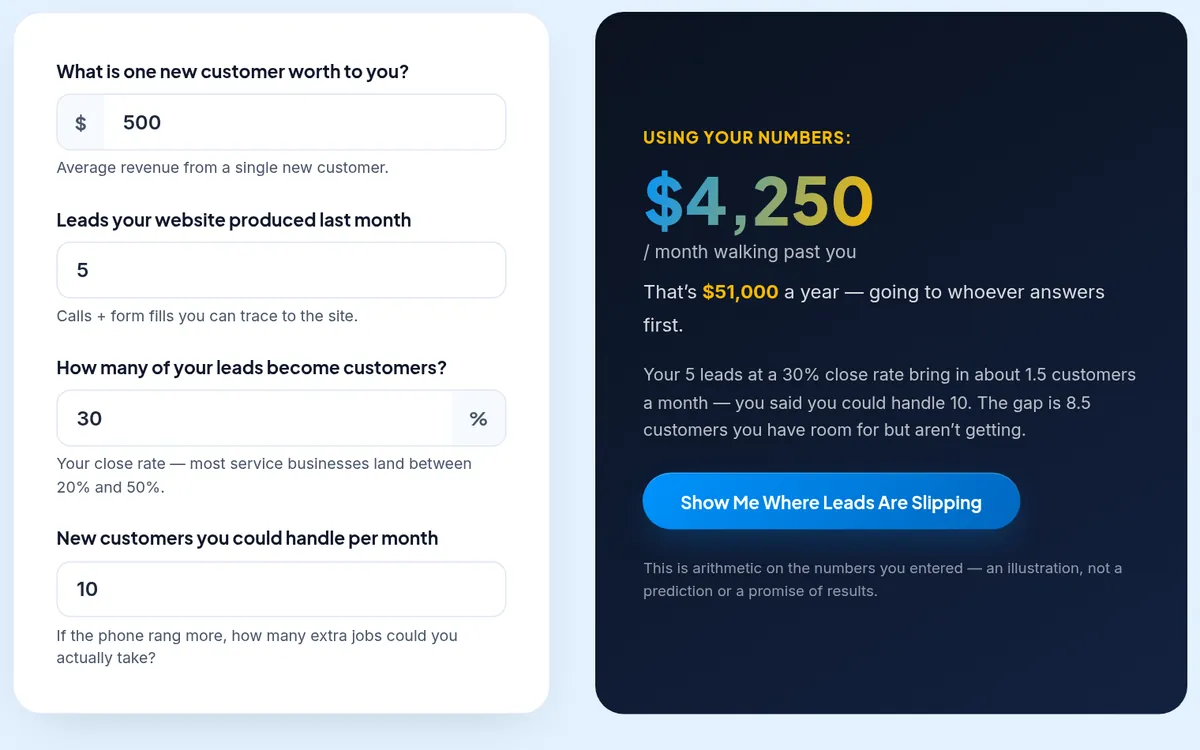
Put a dollar figure on a quiet phone using your own customer value and close rate. An illustration on your numbers — never a promise.
Do the math →
What the audit covers, what you get back, and why there is genuinely no catch.
See what you get →Hyperlocal expertise where it matters; regional reach where it pays. Click any market to see exactly what we do there.
Two earlier pieces covering the basics of paid search.
Grant us read-only access to your Google Ads or Meta account. Within 48 hours we'll send a written audit covering search terms waste, conversion-tracking accuracy, geo and creative gaps, and a projected target CPL.