

Your crawl budget is wasted
Orphaned URLs, conflicting canonicals, JavaScript-rendered nav, and a sitemap full of 404s mean Google never gets to the pages you actually want indexed.
Fix My AdsEvery day you're stuck on Page 2, the shop down the street is pocketing leads that should be yours. Get Us Listed does local SEO for businesses in York PA and across Central Pennsylvania, Maryland and the DC Metro — rebuilding your technical foundation, fixing your Google Business Profile, and earning the rankings that actually move revenue.
We've audited hundreds of local sites across York, Lancaster, and Baltimore. The same root causes show up over and over — and every one of them is fixable.
Orphaned URLs, conflicting canonicals, JavaScript-rendered nav, and a sitemap full of 404s mean Google never gets to the pages you actually want indexed.
Fix My Ads
Inconsistent name, address, and phone across Yelp, BBB, Apple Maps, and 40+ citation sources splits your authority and tanks your local pack ranking.
Fix My Google Profile
Generic service pages with no author bios, no schema, no local proof. Google's helpful-content system buries pages that read like every other contractor's site.
Fix My Website
Either you have no backlinks worth counting, or a previous SEO built a directory dump from 2014. Anchor diversity and topical relevance fix both.
Fix This For MeFive areas, in the order they usually matter. Open the one you care about — the rest stay out of your way.
For a business people search for near them, the Google Business Profile is doing more work than the website. It is what fills the map pack, it is what shows the phone number, and on a phone it is frequently the only thing a searcher ever looks at. A profile with the wrong hours or a category that does not match what you sell will quietly cost you calls that never register anywhere you can see them.
The work is unglamorous and mostly a matter of being thorough. Primary category chosen to match the service people actually search for rather than the one that describes your legal entity. Secondary categories added where they genuinely apply. Service areas set to the places you will actually travel to. Hours that reflect reality, including the holiday overrides most profiles never get. Products and services filled in with the words a customer would use. Photographs that are yours, geotagged or not, rather than stock.
Then it has to be maintained. Google changes the profile interface and its rules regularly, competitors suggest edits to your listing, and an unattended profile drifts. We check it, and when Google introduces a field that matters we fill it in. If the profile is the whole of what you need handled, Google Business Profile management is that work on its own, without the rest of the SEO retainer.
If you want the background before you talk to anyone, we wrote up what a Google My Business listing does and does not do, and what Google looks for when it decides which website to show first.

A citation is any place online that names your business and its contact details — directories, chambers of commerce, industry bodies, data aggregators that feed other directories without ever telling you. Search engines use the agreement between those records as one signal that the business is real and that the details are current.
The problem is almost never that citations are missing. It is that they disagree. A suite number that appears on some listings and not others. A tracking number from an old campaign. A previous address that three directories still carry because they copied each other in 2019. Each individual mismatch is minor; the aggregate is a business that looks slightly uncertain to a system trying to decide whether to show it.
So the work is: find every record, decide the one canonical version of the name, address and phone number, and correct the records that disagree — starting with the aggregators, because those propagate. It is slow, and some directories take weeks to update. It is also the kind of thing that stays fixed once it is fixed.
This runs alongside our citation service, and it pairs with the business-identity check inside our own tooling, which flags a phone number appearing on your site that does not match the one you have told us to use.

On-page work is where most of the durable gains are, and it is the part most often skipped because it requires writing. A page that ranks tends to answer one question thoroughly, in language a customer would recognise, with the specifics — prices, timelines, what is included, what is not — that a competitor is hedging on.
In practice that means: one clear subject per page rather than four services crammed onto one; a title and description written for the person choosing between six blue links; headings that pose the question and sentences underneath that answer it directly rather than warming up for a paragraph; and enough depth that the page is genuinely the better result, not merely longer.
Depth and readability pull against each other, which is why sections like this one exist. The text in every tab on this page is in the HTML the moment the page loads — it is hidden with an attribute, not built by JavaScript after the fact — so a search engine reads all of it while a visitor reads only the part they asked for.
Location pages are their own discipline and the place most local sites go wrong; we set out what to include and what to avoid on location pages separately. If you would rather work through it yourself, the SEO checklist is free and does not ask for an email.

Reviews affect two different things at once, and it helps to keep them separate. They are a ranking input, and they are the thing a human reads immediately before deciding whether to call you. A business can be winning on the first and losing on the second.
The asking has rules. You may ask every customer; you may not ask only the happy ones, offer anything in exchange, or set up a form that filters people to a private complaint box when they select fewer than four stars. Review gating is against Google’s policy and it is not subtle to detect. We set up an ask that is simply well-timed — while the work is fresh, from the person who did it, with a link that lands directly on the review box. That is the right way to ask customers for Google reviews in more detail.
Replies matter more than most owners expect, and a bad review with a calm, specific, non-defensive reply often reads better to a prospect than an unbroken wall of five stars. We wrote about why people trust businesses with more reviews, and about how online reviews and word of mouth now feed each other.
We do not write reviews, and we do not buy them. If an agency offers to, that is the moment to end the conversation. When reviews are the whole problem rather than one part of it, our review and reputation management service is the asking, answering and watching done as a job of its own.

Two numbers are worth watching and most reports bury them under twenty that are not. The first is enquiries — calls, forms, messages — because that is the thing the business actually needs. The second is which pages and which searches produced them, because that tells you where the next hour of work should go.
What we can measure honestly: how many people arrived from search, which pages they landed on, which queries Search Console attributes to you, how many enquiries came in, and how those moved compared with the previous period. What nobody can measure honestly is the counterfactual. We can show that enquiries rose; we cannot prove what would have happened if we had done nothing, and any agency presenting a graph as proof of causation is overstating what the data supports.
Rankings themselves are a poor headline metric. They are personalised, they vary by the searcher’s exact location down to the street, and a position that looks good on your screen may not be what anyone else sees. We report them as context, not as the result.
Timelines are the other place expectations go wrong. Local search moves on a scale of months, not weeks, and the honest answer depends on your competition and your starting point — how long SEO takes to work goes through what actually drives that. If you would rather buy attention while the organic work matures, organic and paid ads solve different problems, and pay-per-click advertising is the faster of the two to switch on.

There are no shortcuts and no algorithm tricks. There's a checklist of things that work, executed weekly, for as long as you want to keep winning. Here's exactly what we do.
We turn your Google Business Profile into a lead magnet and lock down every citation source so Google trusts where you are and what you do.
Core Web Vitals, schema, crawl efficiency, and indexation hygiene. The unglamorous foundation that determines whether anything else you do matters.
Every page mapped to a primary keyword, structured around real search intent, and rewritten with the topical depth Google's helpful-content update demands.
Editorial links, local sponsorships, and digital PR. Anchor diversity and topical relevance — never PBNs, never link farms, never anything that puts you at risk.
Including the ones that are awkward for an agency to answer. Use the filter if you are looking for something specific.
Profile and citation corrections can show up in weeks. Rankings for anything competitive move over months, and the honest range depends on how established the sites above you are, how many reviews they have, and how long they have held the position.
What we will not do is quote you a date. A specific promise — page one by March — is either a guess dressed up as a commitment or a plan to chase a search term so obscure that ranking for it earns nothing. A realistic timeline for local businesses sets out what actually governs the pace.
What you can hold us to is the work itself: what was done, when, and what moved as a result.
No, and neither can anyone else. Google does not sell placement in organic results, does not disclose its weightings, and changes them continually. Any guarantee of a position is a guarantee about a system the person making it does not control.
The version of a guarantee that is real is a guarantee about scope — what will be delivered, by when, for how much — and that is what we put in writing.
It is worth reading the pros and cons of hiring an SEO agency before you sign anything, including with us.
Usually they are ahead for reasons you can identify and several you can act on. A more complete profile. More reviews, collected over longer. Pages that answer a specific question where yours answers a general one. Sometimes simply more years in the index.
The first step is finding out which of those it is, because the answer changes what is worth doing. There is no point writing pages if the profile is miscategorised, and no point chasing reviews if the site does not load on a phone.
We went through this for one area specifically in why your competitors outrank you, and for a trade in how contractors in York County are getting more calls from Google.
It matters differently. Assistants answering a question about local businesses are drawing on an index, on structured data, and on the same profile and review signals that feed search — so the work overlaps far more than the framing suggests.
What changes is the shape of a good page. Being cited requires being extractable: a question-shaped heading answered directly in the first sentence beneath it, the business named in the prose rather than only in the logo, figures that carry a source, and schema that backs up what the page says.
There is a trap here worth naming. The “block all AI bots” robots.txt snippets circulating online do not distinguish between crawlers that collect training data and crawlers that build the index assistants cite from. Copying one removes you from AI answers entirely. We treat those as separate decisions, because they are. More on the shift in how AI is changing the way customers find local businesses.
Buy or write reviews. Gate review requests so only happy customers reach the public form. Build link networks or buy links. Spin one page into twenty near-identical location pages that differ only by town name. Publish invented statistics or a testimonial from a client who does not exist.
None of that is squeamishness. Each is a documented policy violation with a real chance of a manual penalty, and the cleanup costs more than the work was ever worth.
The commonest own goal is subtler: the SEO mistakes that quietly hold a site back are usually things done with good intentions.
Everything. The website, the domain, the hosting account, the Google Business Profile, the analytics property, the Search Console property, the content and the citation corrections. They are registered in your name or your company’s, not ours, and we will hand over access rather than make you ask twice.
This is worth checking with any agency before you start, not after. An arrangement where the agency owns the domain or the ad account is one where leaving costs you the asset.
A short summary of what was measured in the period: visits from search and how that compares with the previous period, enquiries received, the pages that earned them, page-quality scores for anything published or updated, and the next thing we intend to work on.
Deliberately absent: any sentence claiming our work caused a number to move. We can show a number moved. Causation in search is not provable from this data and stating it anyway would be the most flattering thing in the report and the least true.
Where a section has nothing measured, it is left out rather than shown as a zero — a zero reads as a result, and an absence of data is not one. If you want to understand the underlying numbers yourself, how to use Google Analytics is a reasonable place to start.
Crawl and indexation fixes show up in Search Console within 2–4 weeks. Core Web Vitals improvements register on Google’s side within 28 days. Ranking lift typically follows in months 2–3 once Google re-evaluates the cleaned-up site. The fastest way to start is the free audit request — email reply within 48 hours.
Experience, Expertise, Authoritativeness, Trust — Google’s framework for deciding whether a page deserves to rank. We add author schema, real bylines, original local photography, and on-page proof so your site signals all four. The same local SEO fundamentals drive results for electricians, plumbers, and HVAC companies. Our plain-English marketing glossary defines E-E-A-T and the rest of the vocabulary you’ll meet in SEO reports.
We audit every existing citation across 50+ data aggregators (Yext, Data Axle, Foursquare, Apple), correct mismatches, suppress duplicates, and submit a master record so your name, address, and phone match everywhere Google looks. Electrical contractors get a dedicated walkthrough in the electrician marketing playbook.
Anchor-text diversity (branded, naked URL, partial-match, exact-match in the right ratio), referring-domain growth from topically relevant sites, and zero footprint from link farms. We build slowly and editorially because the alternative is a manual penalty.
No. We work month-to-month after a 90-day foundation phase. You own every asset, every report, and every login. If we stop earning the relationship, you walk. How pricing works covers the billing detail, including what is and is not inside the monthly fee.
Not a blog for its own sake. Your service and service-area pages do most of the ranking work for a local business. Articles earn their keep when they answer questions your customers genuinely ask — what a repair involves, how permits work in your county, what affects cost. Publishing thin weekly posts just to look active doesn’t move rankings, and Google’s helpful-content systems can hold it against you.
Only for towns where you do real business and have something genuine to say — jobs you’ve done there, specifics of serving that area. A pile of copy-paste pages with the town name swapped out reads as doorway content, and Google either ignores it or holds it against the site. We start with your core service area and expand town pages as the work supports them.
Yes — the compliant way. We set up a simple ask process: a direct review link, guidance on when to ask after a job, and responses to every review that comes in. What we won’t do is buy reviews, write fake ones, or filter out unhappy customers before they can post, because all of that violates Google’s policies and risks your profile. Steady, real reviews win over time. If you want to work on the profile yourself first, the full Google Business Profile power-up checklist we use during onboarding is published free on this site. And when reviews come in, our free review response templates give you nine owner-voice replies to copy.
Nothing collapses overnight. The technical fixes, content, citations, and links we’ve built stay yours and keep working. What fades is momentum — competitors who keep publishing, earning reviews, and maintaining their profiles will gradually close the gap and can eventually pass you. Think of it like fitness: stopping doesn’t erase the work, but the edge erodes while others keep training.
Yes — this describes most of the businesses we work with. Google supports service-area businesses directly: your Business Profile hides your home address and instead declares the counties and towns you serve. Rankings then hinge on your service-area settings, reviews, citations, and site content matching those areas. Done right, a contractor working out of a home office competes fully in the local pack.
Sometimes SEO alone is enough. If the site loads fast, works on a phone and makes the next step obvious, we can rank what is already there. If it does not, ranking a page that loses the visitor is spending money to fill a leaking bucket — that is when we talk about rebuilding the site first, and we will tell you which of the two you are in before you commit to either.
Often, yes. SEO compounds over months; paid search buys visibility from the first week. Running both means you are not waiting in silence for results, and the search terms the ads prove profitable tell us which pages to prioritise organically.
National SEO is a budget war you don’t need to fight. Local SEO is decided by three things Google weighs inside your service area: proximity, relevance, and prominence. You’re not competing with every plumber in America — you’re competing with the handful in York County who show up on the map when someone nearby searches. That changes the playbook entirely. A complete Google Business Profile, consistent citations, service pages written for your towns, and a steady flow of real reviews carry more weight here than the raw domain authority national brands lean on. A well-run local business can outrank much bigger sites in its own backyard, because Google wants to show searchers a nearby business it can verify. That’s a winnable game.

If you’ve ever paid for SEO and wondered what happened each month, here’s our answer in plain terms. Every month we publish or refresh content mapped to real searches, post updates and photos to your Google Business Profile, respond to new reviews in your voice, check your citations for drift, strengthen internal links, and watch Search Console for crawl errors and ranking movement. Then we send a report in plain English: what we did, what moved, what’s next. SEO compounds over months, not days — the early months are foundation work, and the payoff builds as Google re-crawls and learns to trust the site. If an agency can’t tell you what they did last month, that’s your answer.
Three free ways to see exactly where you stand — two run instantly in your browser, one is a real audit by a real strategist.

Ten yes/no questions — the same ones we open paid audits with. Instant score and a personalized gap list. Nothing is submitted anywhere.
Run the free check →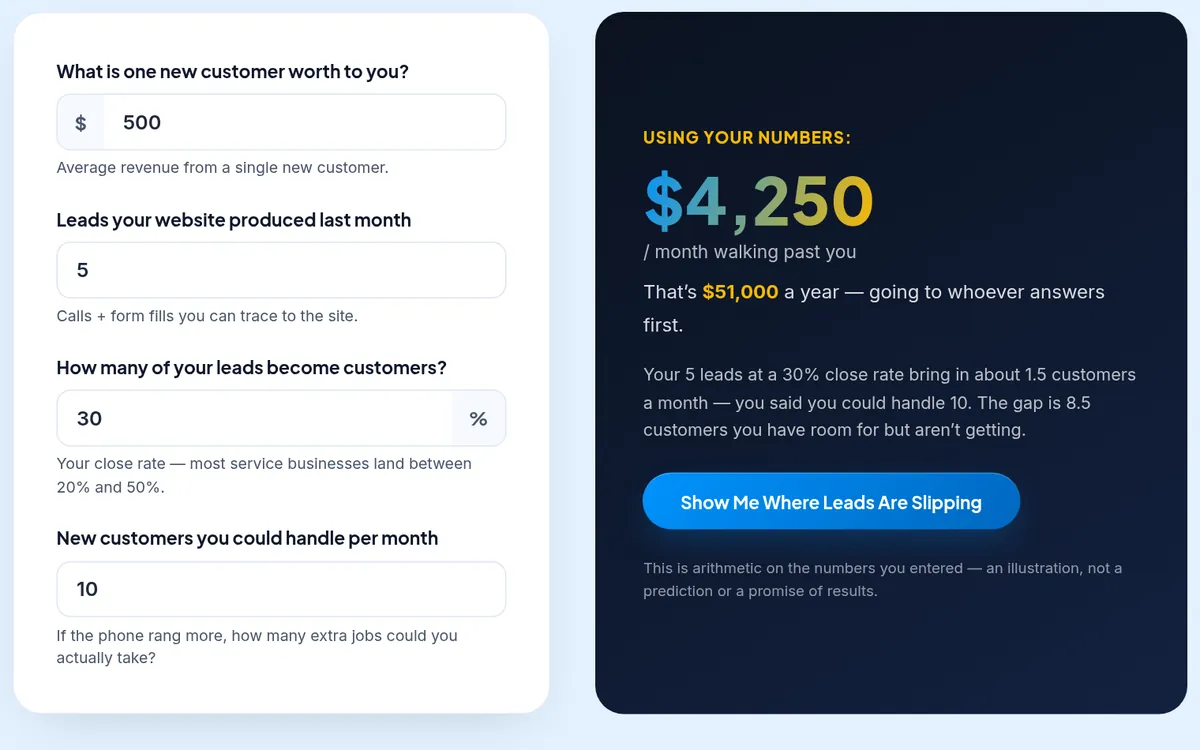
Put a dollar figure on a quiet phone using your own customer value and close rate. An illustration on your numbers — never a promise.
Do the math →
What the audit covers, what you get back, and why there is genuinely no catch.
See what you get →Hyperlocal expertise where it matters; regional reach where it pays. Click any market to see exactly what we do there.
Grouped by subject. The last group is older material kept for reference.
Send your URL and 2–3 keywords you want to win. Within 48 hours we'll send a written audit covering technical issues, on-page gaps, GBP grade, and a prioritized 90-day plan. No sales call required.